
What to Buy and What to Eat at Mahane Yehuda Market
31 July 2026
There are two ways to walk into Mahane Yehuda Market. You can come to eat — and then the market is a row of counters, bar stools and the smell of the grill. Or you can come to shop, and then it is something else entirely: hundreds of stalls selling things you can take home, and most of them will let you taste first.
This guide is about the second way.
Halva
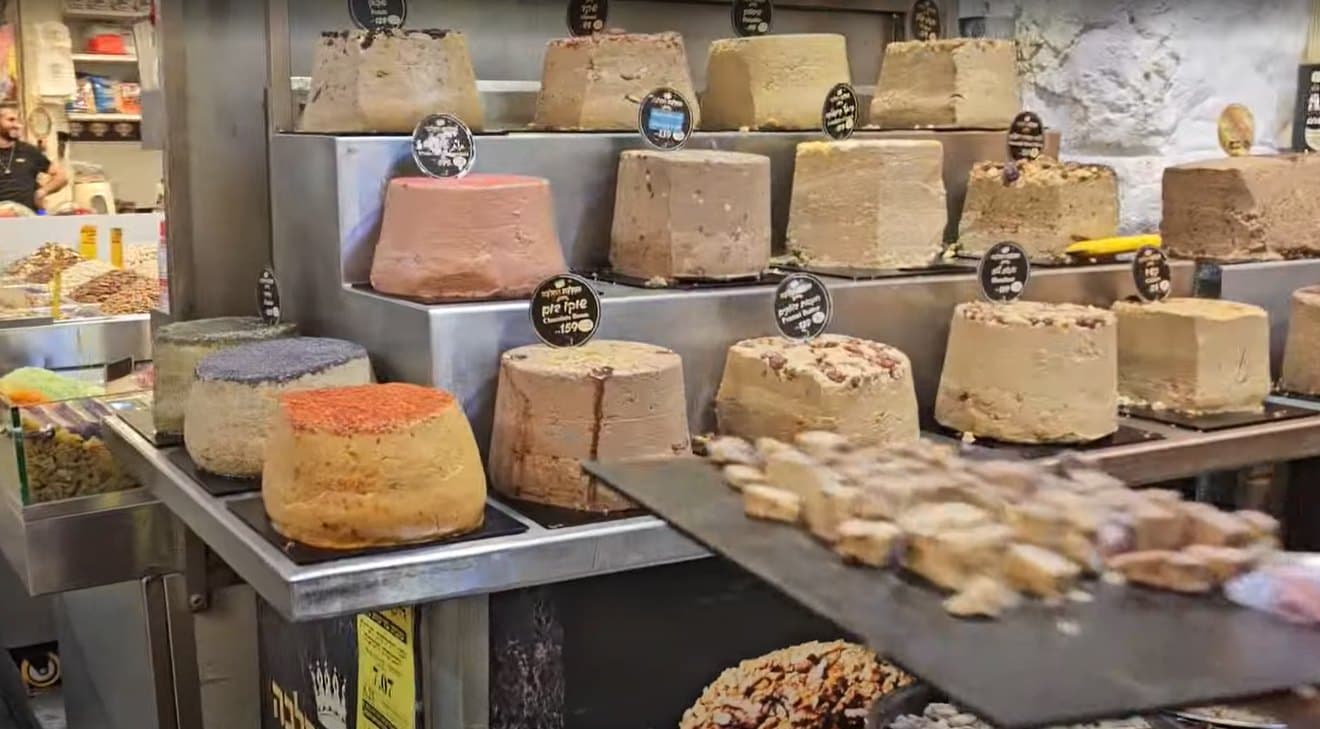
The first thing you see, and rightly so. Halva in the market is not sold pre-packed but in blocks — half-meter-tall cylinders cut to order by weight. Pistachio, chocolate, coffee, vanilla, and another ten flavors that change from stall to stall.
The one rule worth knowing: always ask to taste. It is completely normal, nobody will look at you strangely, and the difference between good halva and great halva shows up in a single bite. And buy less than you feel like buying — it is far richer than it looks.
Nuts and dried fruit
The long stalls with dozens of open bins: almonds, walnuts, pistachios, seeds, and beside them apricots, figs, dates and dried mango. Here too, you taste before you buy.
Dried fruit in the market is significantly cheaper than in the supermarket, and usually better. If you are buying for guests, this is the place.
Turkish delight
Powdered-sugar-dusted blocks piled in huge bowls. The tidier stalls label every flavor: classic red, classic white, pistachio, mango. Alongside them, jars of tahini and trays of baklava.
Turkish delight is one of the easiest things to miss in the market because it does not shout for attention, and it is one of the best souvenirs you can carry — it keeps for weeks and will not get crushed in your bag.
And next to it, at a few of the stalls, knafeh — which is eaten hot on the spot and not taken home. If you see a tray coming out of the oven right now, that is your moment.
Cheese
Two addresses on Etz HaChaim Street, both long-established:
Basher Fromagerie, 53 Etz HaChaim — a cheese shop with a European selection, delicacies and wines. The market branch opens at six in the morning on Fridays, an hour when most of the city is still asleep and the market is already at full tilt.
Ma'adanei Tzidkiyahu, the cheese stall at 63 Etz HaChaim — part of the chain that has been trading in the market since 1967.
Olives and the deli counter
Ma'adanei Tzidkiyahu started right here in 1967 with exactly this — olives. Today it is a small chain with three stalls on Etz HaChaim Street: the main deli at number 70, the cheese stall at 63, and a meat branch with seating at 27 that stays open in the evening as well. All of it is kosher.
Olives in the market are sold from open tubs in dozens of varieties, and here too — you taste.
Fruit and vegetables
This is still a produce market, even if that is easy to forget between the bars. The inner alleys are where to go: prices are significantly lower than the supermarket, and in the last hours of Friday, when the stalls want to clear their stock before Shabbat, they fall through the floor.
Alcohol
The market has a few wine and beer counters that work like a shop rather than a bar: shelves of bottles, prices written on cardboard signs, and sometimes a wine deal somewhere in the ₪25 to ₪35 range. It is not a place for connoisseurs, but if you need a bottle for dinner tonight, it is cheaper than any shop in the city.
And when to come
A weekday morning — the calmest, the easiest for talking to the sellers, and the easiest for tasting.
Friday morning — the market at its peak, and also at its most crowded. If you have come for the experience, this is the time. If you have come to shop in peace, it is not.
Friday afternoon — the best hour for prices, and the worst for choice. Whatever is left is what is left.
And if you stayed to eat
This article is about what you take home, but it is hard to leave the market without eating. Three places that represent three different generations of the market:
Hatzot, 121 Agrippas Street — the oldest of them. Opened in 1970 by the brothers Avraham and Michael Ajami, and the second generation is still running it. The Jerusalem mixed grill is what made its name, and the name itself came from a concept that was pioneering at the time: open from midnight (hatzot in Hebrew) until the small hours. Even today they close "when the last customer leaves".
Halati, 9 HaEgoz Street — challah bread stuffed with schnitzel, with eggplant and matbucha (a cooked tomato and pepper relish). Simple, mehadrin kosher (the strictest level of kosher supervision), and one of the market's permanent lines.
Nona, 3 HaTut Street — a mufleta bar (mufleta is a thin Moroccan pancake) named after the grandmother of chef Itzik Levy. The mufleta here is not a dessert but the base of a full dish: the flagship, "We've Arrived at Mahane Yehuda", is mozzarella, Bulgarian cheese, coriander pesto, roasted peppers and dried tomatoes.
All three are kosher, and all three are closed on Shabbat.
Three things worth knowing
Bring cash. Most stalls take cards, but not all of them, and the line behind you does not like waiting.
Do not be shy about asking for half. Half a kilo, a hundred grams, two pieces — this is a market, not a supermarket.
Taste. It is the one rule that repeats in every section here, and it really is the most important one.
A letter about what's on in the city, usually once a week. It may also carry offers, and some links may be partner links. You can unsubscribe from any letter.